For brands launching a collection
Logo & private label
Start with a base silhouette. Add your chest print, embroidery or neck label and review the logo placement on a sample.
Discuss your branding
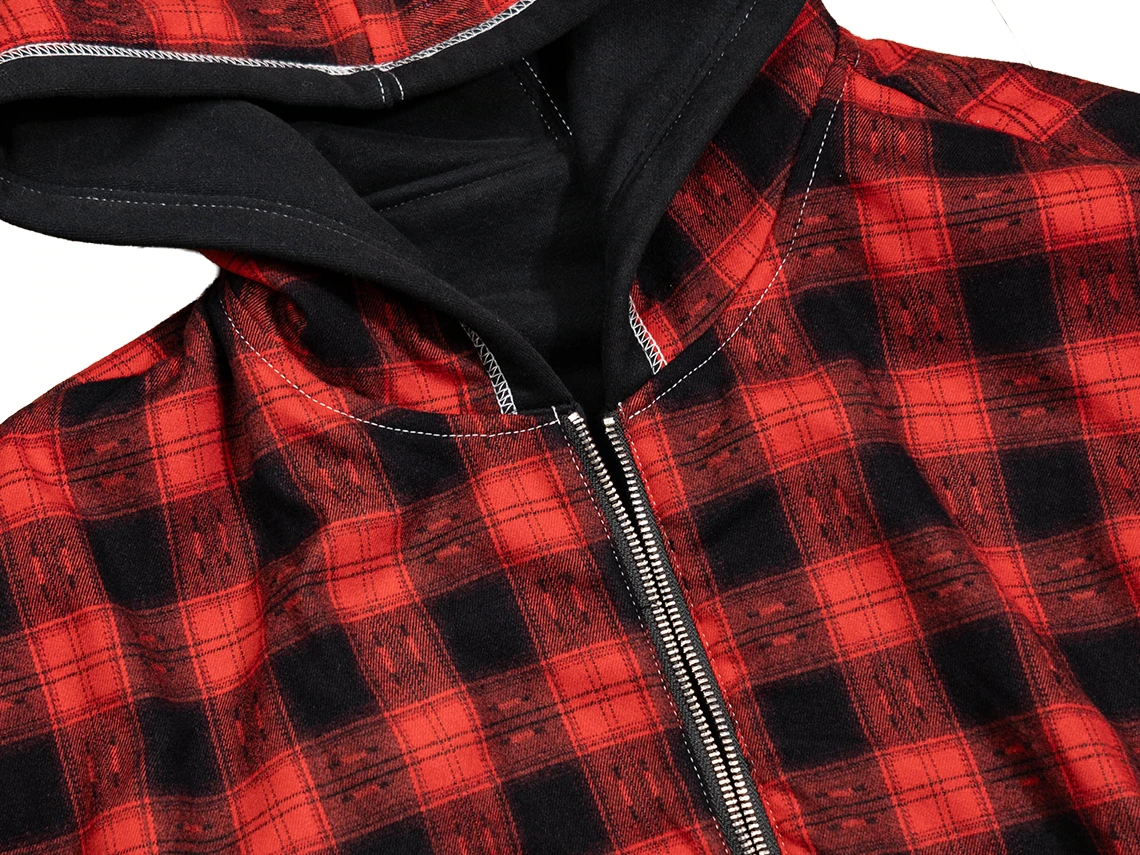
What can change on an existing hoodie?
Start with a sample whose shoulders, sleeves and body length already fit your customer. Photograph the inside neck, side seam and zipper. Mark each change on the photo. A printed inside-neck mark needs a smooth area for the transfer. A flag label caught in a closed side seam may need that seam opened and sewn again.
For a branded zipper pull, show the existing slider, the attachment point and the length you want the pull to hang. Ask which pull fits that slider and whether a custom shape needs tooling. If your brief also changes the body length, lining or pocket position, have those pattern changes quoted separately.
Custom main labels, hangtags and packaging bags
Send the artwork for all three items with the same style code. Include the quantities for each size or color wherever the copy changes. For approval, ask to see one finished garment with the label sewn in, the hangtag attached and the garment folded in its bag.

Main brand label
For a woven or printed neck label, send your logo at actual size, the finished width and height after folding, and a sketch showing the fold and stitch lines. Mark the position inside the garment and show whether the size sits on the main label or on a separate tab.
Sample check. Read the smallest letters on the sewn label. Check that the seam clears the logo, the label sits level at the neck and the folded edges feel comfortable against the skin.

Hangtag
Supply front and back artwork with the trim size, paper stock or reference tag, hole position, cord and attachment point. If the tag carries a price or barcode, identify which fields change by style, color or size and send the matching data.
Sample check. Handle a printed tag to check the stiffness and finish. Scan the actual barcode if used, match it to the garment size and check that the hole and cord leave the artwork visible.

Packaging bag
Measure the garment folded as it will ship. Specify the usable inside dimensions, preferred material and finish, closure, logo position and any size sticker. A bulky hoodie may need a different bag from a tee, so include the thickest folded size in the trial.
Sample check. Pack the garment and close the bag. Check that the opening clears the fold, the closure holds without pulling and the size sticker is readable. Match the sticker to the sewn label and hangtag before approving the packing sample.
What to send
Explore decoration techniques- Identify the base garment and color. Note which parts of the original sample you want to keep.
- Send your logo file, finished artwork dimensions and placement measured from a seam. Include thread or print color references.
- List neck labels, care labels, hangtags and packing requirements along with the quantity by size and color.
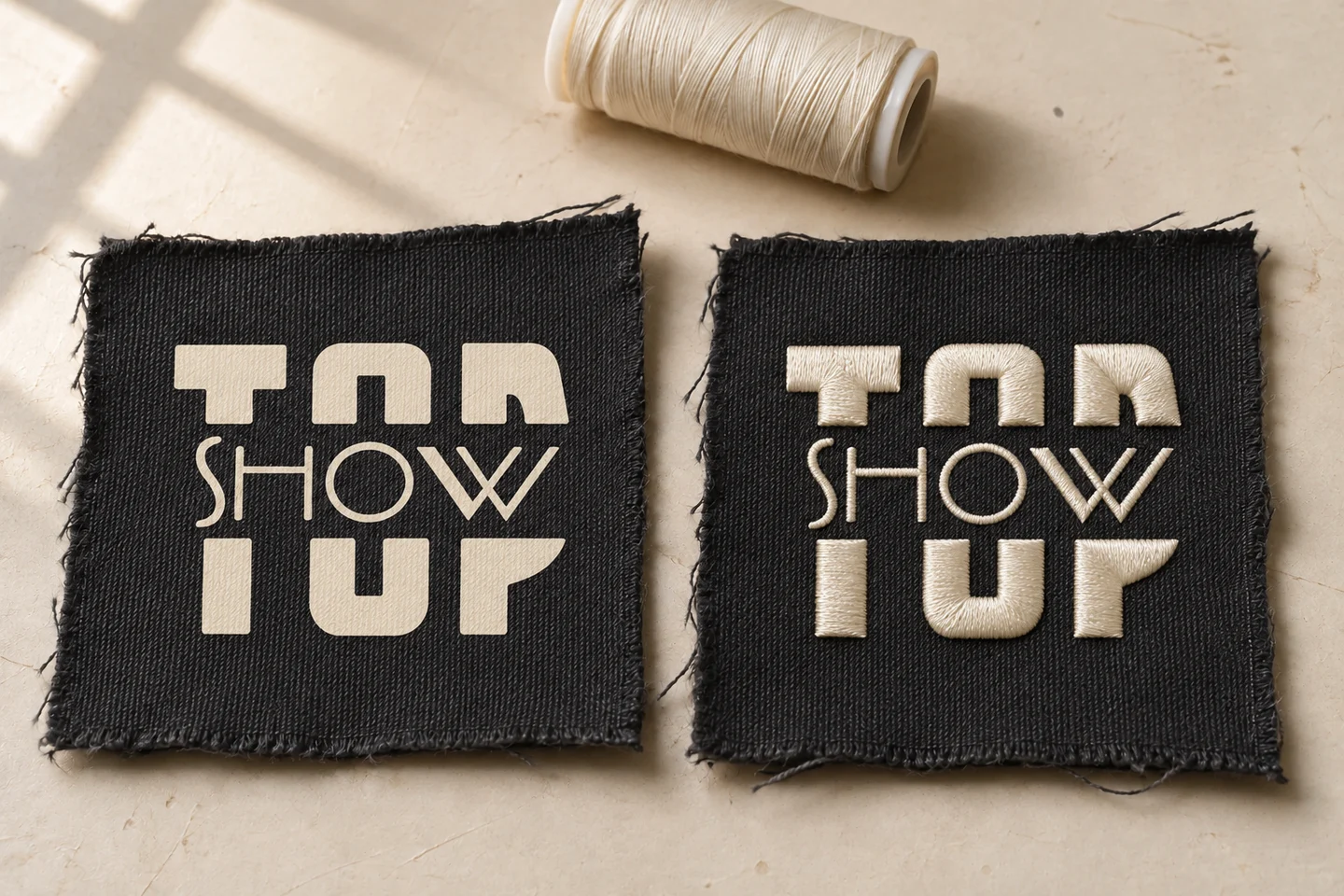
The same chest mark in ink and thread
Look at the thin SHOW lettering through the middle of the TOPSHOW mark. On the printed swatch, check the open center of the O and the ink coverage in the heavier shapes above and below it. On the embroidery, check that the fine strokes stay separate and the surrounding knit lies flat.
Give both trials the same finished width and use the proposed garment fabric. On a complete sample, photograph the mark straight on and on the wearer. A proof can settle which version reads clearly. The garment shows whether the position still works beside a pocket or under an open jacket.
What to check on the sample
Logo placement
Measure from the agreed seam to the artwork edge. Check its position while wearing the sample, especially near a zipper or pocket.
Decoration finish
Read the smallest lettering at actual size. Check embroidery for puckering, or inspect the edges and coverage of a printed logo on the selected fabric.
Labels and packing
Check that the neck label sits flat, its size marking matches the garment and the folded presentation shows the branding you approved.
Write an artwork brief that survives sampling
Supply the original artwork file, version date, intended dimensions and physical color references if available. Show a front or back view and measure placement from repeatable points. For a center-chest print, mark the garment center line and the distance from the front neck seam to the top of the artwork. Specify whether the artwork keeps one width across sizes.
For a spot-color screen print, review the color separations with the printer. Each ink color uses a separate screen, and a dark garment may need a light underbase. Request a strike-off on the intended color. Look closely where two colors meet, at thin outlines and across large solid areas. Record the approved ink colors and artwork version together.
Approve embroidery from both sides
Ask for the motif at its actual size on the intended knit. Coats identifies fabric stretch, design size and stitch density among the factors in backing selection. A small emblem on a stretchy tee and the same emblem on a firm jacket can need different support. Compare the face while the fabric is relaxed, then inspect the backing against the skin side.
On our embroidered zip hoodie, fasten the zip to check how the two halves of the lettering line up. On your sew-out, check that small lettering stays open, the outline meets the fill and the surrounding panel lies flat. If a tip or letter disappears, circle the exact area in a close-up and request a revised sew-out. Keep that proof with the approved thread color and placement drawing so a later colorway has a clear starting point.
Proof the neck label, care label and packaging together
Lay out the brand label, size tab, care label, hangtag and bag sticker for one finished size. Check the spelling and size on each, the fold direction of a woven label and how much space the seam takes up. On the sewn sample, open the neck and side seam to verify that the information remains legible.
Tell the supplier where the garments will be sold. For most textiles sold in the United States, the FTC textile labeling guide identifies fiber content, country of origin and the responsible business as required disclosures. Its care-label guidance also calls for evidence supporting the instructions. Confirm the wording for the finished garment, including its decoration, before printing the label run.
Printed neck mark or sewn hem tab?
For a tagless neckline, send the artwork at its finished width and mark its distance below the back-neck seam. Request a transfer on the actual garment color. On a lightweight tee, look at the outside for show-through. On dyed polyester, check a pale transfer for dye bleeding through. Flex the cooled print and review it again after the agreed wash.
A folded hem tab gives the brand a visible mark when the garment is worn. Sketch both faces with the fold line and sewing line marked. For a tab wrapped over a sleeve hem, turn the sleeve over to check that both faces read upright. On a side-seam flag, measure how far it projects and check that the stitching clears the smallest letter.
When replacing an existing label, mark which size and care details must accompany the new branding. The label proofing section covers the information to check before approving the printed copy.
Approve the same brand color on different materials
If navy is your signature color, send a physical reference and name the material it represents. A Pantone TCX cotton swatch gives the garment team a textile reference. Ask for a paper proof on the chosen hangtag stock, a thread or woven-label sample, and a print on the chosen bag film. The uncoated card and translucent film can give the same artwork a different appearance.
Lay the proofs beside the approved garment under the same lighting. Put the folded garment inside the bag before judging its print. Mark the accepted proof for each material with the colorway, date and artwork version. If one needs revision, identify the exact piece and direction of change, such as “bag print needs to be darker against the charcoal tee”.
Map each size and color to the right retail ticket
Ask the buyer or warehouse for its packing instructions before laying out the ticket. One retailer may receive mixed-size cartons while another asks for each size separately. Identify the destination and packing rule on each purchase-order line.
For example, a hoodie in black and stone, each in S, M and L, has six sellable variants. Where the sales channel uses GS1 identifiers, each variant needs its own GTIN. Give the packing team the approved data file. A human-readable style code helps with the visual check, while the barcode should scan to the exact variant in the receiving system.
| Garment | Hangtag & bag sticker | Scan result |
|---|---|---|
| Black · M | BLK-M on both | Black hoodie, medium |
| Stone · M | STN-M on both | Stone hoodie, medium |
Cost the first run and the reorder separately
Ask for separate lines for the base garment, decoration per placement, labels and packing. For custom trims, ask whether the quote includes artwork setup, tooling, a physical proof and attachment to the garment. Confirm the minimum for each trim, how it splits by color, and who holds any surplus. A garment quantity alone does not tell you how many labels or pulls will be made.
Suppose your next delivery repeats the same hoodie but adds a new color. Send the previous order reference, the approved sewn sample, the trim colors and the artwork revision. List what stays the same and what changes. Ask for a new proof of the affected detail and fresh availability for the material before setting the delivery date.
Order terms
Compare all services- Minimum order
- Depends on the base garment, artwork and label run.
- Sampling
- Timing follows artwork review and selection of the base garment.
- Sample fee
- Based on the blank, decoration setup and custom labels.
- Bulk order
- Quoted by piece count, decoration placements and packing.
Get a quote for private label
Discuss your brandingTechnical references
- ScreenPrinting.com · Screen printing on T-shirts
- Coats · Embroidery and backing selection
- Dutch Label Shop · Fold types for sewn labels
- Transfer Express · Printed inside-neck labels
- STAHLS’ · Dye migration in heat transfers (PDF)
- YKK · Jacket zippers and custom slider options
- Pantone · Color systems for graphics and textiles
- GS1 · Identifying size and color variants